
A refillable perfume runs through the same production stages as any other fragrance: compounding, resting, filling, sealing, quality control and pack-out. What changes is where the risk sits in each stage. Running every stage under one scope and splitting them across two suppliers produce different answers at the same six points, and the differences show up most clearly at the handover.
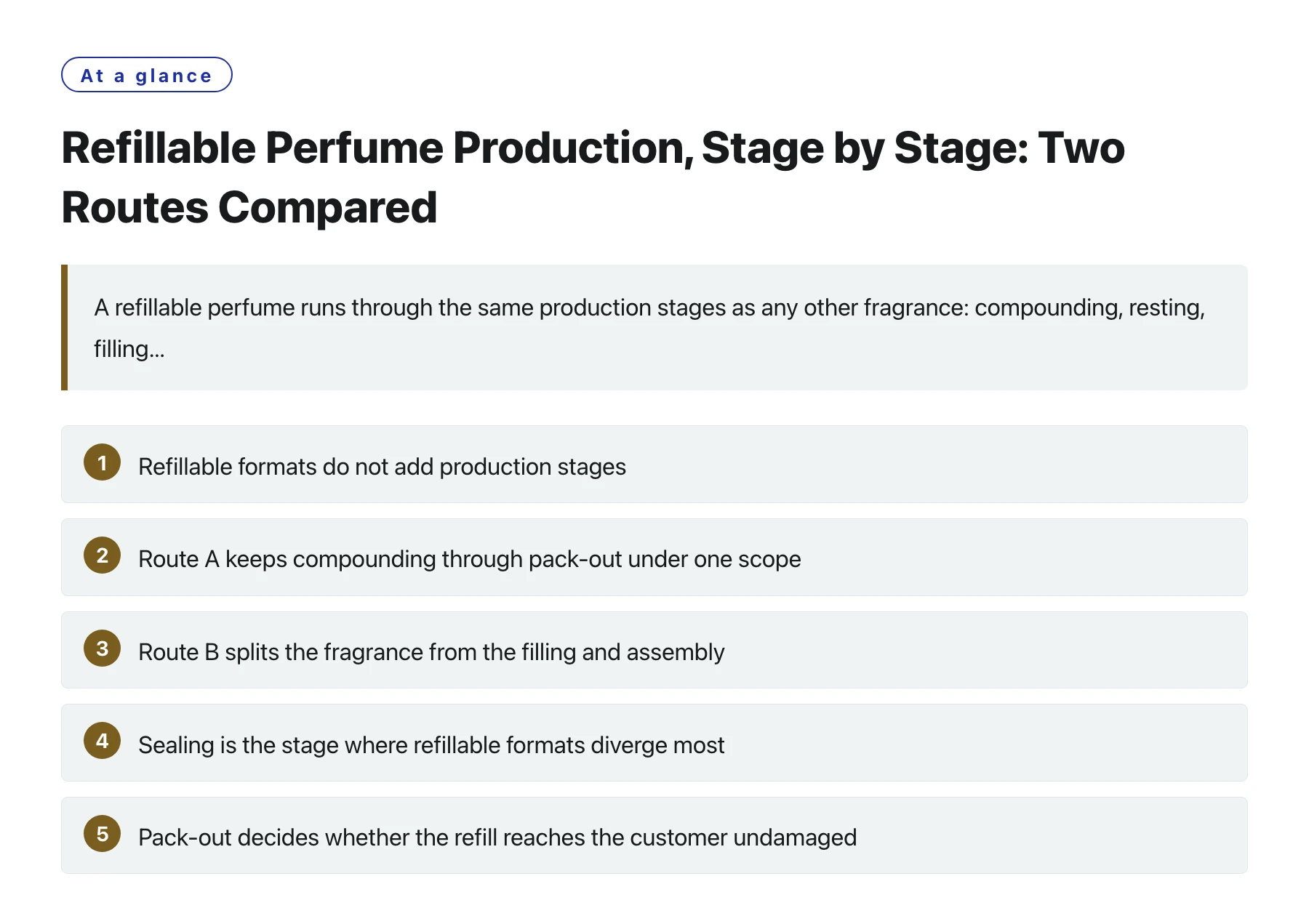
Key takeawaysRefillable formats do not add production stages, they redistribute risk within the existing ones, particularly filling, sealing and pack-out. · Route A keeps compounding through pack-out under one scope, so the fill tolerance and the leak test are set by the same team that fills. · Route B splits the fragrance from the filling and assembly, which can widen the supplier pool but creates a handover where the specification has to be complete. · Sealing is the stage where refillable formats diverge most, because the closure is a working part rather than a one-time seal. · Pack-out decides whether the refill reaches the customer undamaged, and it is the cheapest stage to get wrong and the most visible when it goes wrong.
Discussions about manufacturing routes usually turn into a discussion about suppliers. It is more useful to walk the production stages and ask, at each one, who holds the specification and who holds the risk.
Route A, the single-scope route, keeps compounding, resting, filling, sealing and packing in one plant. Route B splits the work, typically with the fragrance produced by one partner and the filling and assembly done by another, sometimes closer to the market.
Neither route is correct in the abstract. The comparison below is written so a buyer can see which stages become harder on each route, and therefore which questions to ask before choosing.
Why the same stages behave differently on a refill
A sealed bottle is filled, closed and forgotten. A refill is filled, closed, opened, closed again and eventually replaced. That repeated opening is what turns an ordinary production stage into a durability question, and it is why refill programmes tend to have a longer validation phase than their unit count would suggest.
Perfumery is applied chemistry, and the behaviour of a material depends on the molecule rather than on the description attached to it. Two formulas that smell similar can behave very differently in contact with a seal, which is why compatibility work belongs to the production plan and not only to the perfumery brief [1].
The stages are fixed, the responsibility is not
Compounding, resting, filtration, filling, sealing, quality control and pack-out exist on both routes. What differs is how many organisations touch each stage and how much of the specification crosses an interface between them.
On a refillable format this matters more than usual, because the tolerance, the closure torque and the leak test are linked. Changing one without the others is how a programme ends up with a pack that passes every individual test and still leaks in a handbag.
Where the fragrance itself is decided
Both routes begin with a formula, and both are expected to respect the safety assessment that governs how a material may be used [2]. The difference is whether the fill tolerance is written by the same team that writes the formula, or negotiated across two companies.
That negotiation is not fatal, but it has to be explicit. A split route needs the dosage, the carrier and the fill volume stated in the same units in both contracts.
Stage by stage: single scope versus split scope
| Production stage | Route A: single scope | Route B: split scope |
|---|---|---|
| Compounding | One team compounds to the approved formula and holds the batch records | The fragrance house compounds; the filling partner receives bulk and its own documentation |
| Resting | Resting happens in the plant that will fill, so timing is coordinated internally | Resting may finish at one site and the bulk ships before the intended window |
| Filling | Fill tolerance and line settings are set by the team that wrote the specification | The filling partner works to a tolerance it did not design and may not be able to hold |
| Sealing | Closure torque, seal material and leak test are developed together | Seal performance depends on a component the filling partner may not have specified |
| Quality control | One release decision covers fragrance and pack | Two release decisions, with the brand reconciling the results |
| Pack-out | Packing specification, protection and palletisation sit together | Configuration is decided by the brand and executed by a partner without sight of the pack trials |
Read the middle and right columns together: the split route does not remove work, it moves work to the brand.
Where the two routes actually diverge
Three points decide whether a refillable programme runs quietly: the handover, the leak test and the retained reference. All three are cheaper to manage on a single scope, and all three can be managed across a split.
The handover is where a specification goes missing
Bulk leaving one site for another should travel with the same information a single plant would keep internally: which batch, which formula version, when it was compounded, what was already tested. When the fragrance and the pack are handled separately, the pack's own trials are the part most often left behind.
This is the practical argument for a partner that covers the whole sequence, such as fragrance manufacturing under one roof, and equally the reason a split route needs a written interface agreement rather than goodwill.
The leak test is a production stage, not a formality
A closure that is crimped once can be checked once. A closure that will be reopened needs a test that simulates reopening, and that test has to sit at the end of the line rather than in a separate laboratory exercise.
The whole sequence from compounding to sealed unit is what a buyer should be able to see, which is the subject described under perfume manufacturing process.
The retained reference decides future disputes
Both routes should retain a sealed reference from the approved batch, and both should agree how long it is kept and how it is stored. On a refillable programme the reference has two parts, the fragrance and the filled refill, because either can drift.
Where the brand wants the simplest possible line of responsibility from formula to finished unit, a single partner from formula to finished bottle is a reasonable place to start the comparison, provided the cost of that simplicity is still visible in the quote.
For premium positioning, fine fragrance manufacturing adds a further consideration: the higher the finish, the less tolerance there is for a pack that looks different after the second refill.
A question that separates the two routes quickly: who signs the fill tolerance, and who is responsible if the line cannot hold it? On a single scope the answer is one team. On a split scope it should be written down before the first order, not after the first rejection.
Sources
- Chemistry World (Royal Society of Chemistry) —— The Royal Society of Chemistry's magazine, covering chemistry research and explanations of everyday materials including aroma compounds.
- IFRA: Safe Use and Fragrance Science —— IFRA's explanation of how fragrance materials are scientifically assessed for safe use and how those conclusions are applied by the industry.
Frequently asked questions
Does a refillable format need extra production stages?
No, but it extends the ones that already exist. Filling, sealing and pack-out each take longer because the closure has to survive repeated use and the refill has to be protected as a sellable component, not just as a container.
Is a single-scope supplier always cheaper?
Not necessarily. Single scope removes handover risk, which has a cost of its own, but a split route can win on component price or on local filling. The comparison should include the cost of managing the interface, not only the invoice lines.
What documents should travel with bulk between two sites?
Batch identity, formula version, compounding date, quantity, and any testing already performed. Without those, the filling partner is working blind, and the brand carries the risk of a mismatch that only appears after the refill has been sealed.
Can a refillable pack be validated after tooling is cut?
It can be tested, but the cheapest corrections are gone. Seal material and closure geometry are best settled before tooling, with validation confirming the choice rather than searching for it.