
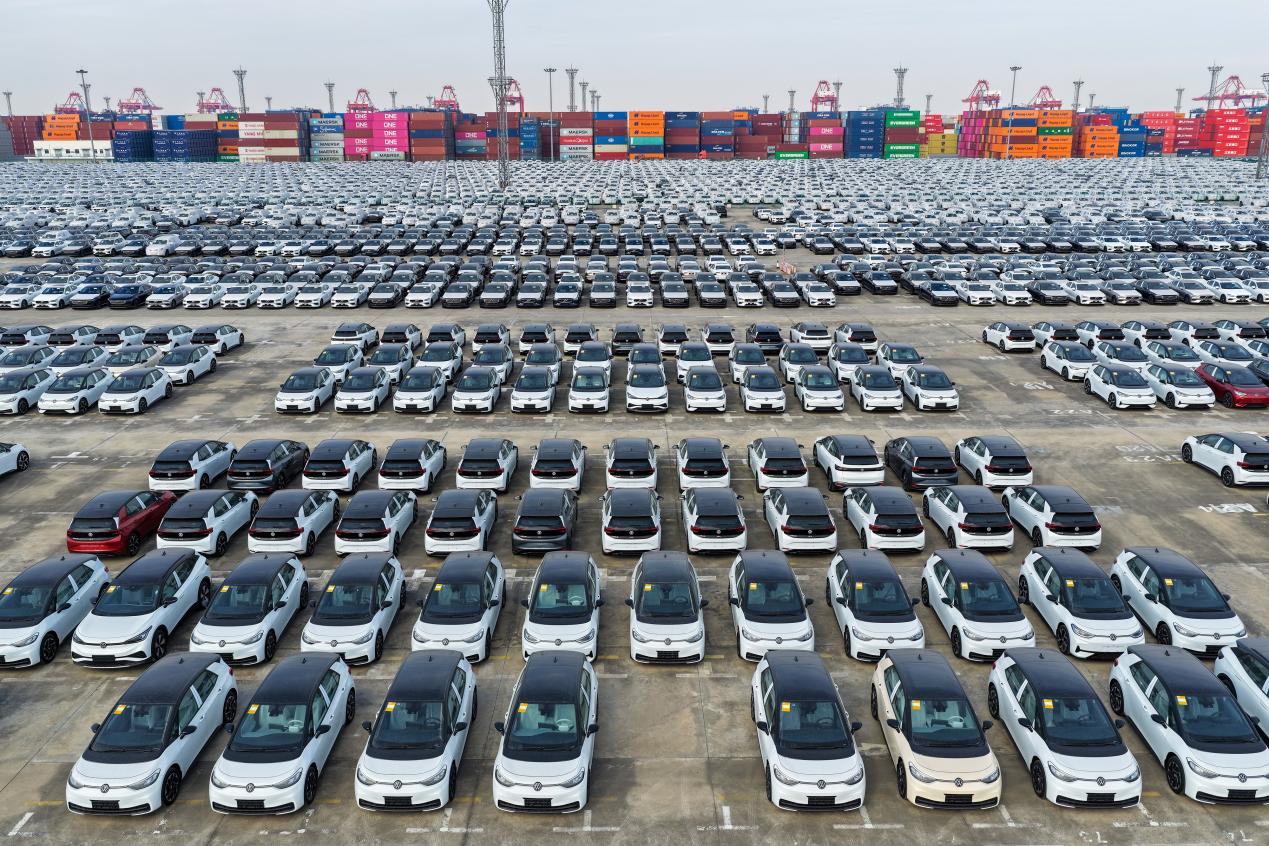
The first quarter of 2026 has marked a definitive shift for China’s New Energy Vehicle (NEV) industry, moving from a phase of high-volume expansion to one of high-density technical leadership. As an observer of global industrial chains, I find the data from 2025 particularly telling: China exported over 7 million automobiles, with NEV exports reaching 2.615 million units—a staggering year-on-year growth rate of over 100%. This is not merely a story of shipping hardware; it is the export of a sophisticated, vertically integrated smart economy. The transition into the 15th Five-Year Plan (2026-2030) is now being underpinned by breakthroughs that solve fundamental "pain points" in range, charging, and autonomous perception.
The technical specifications released this March suggest that Chinese firms are widening their competitive moat. Huawei’s introduction of the 896-line LiDAR system is a prime example of engineering optimization; by offering 4x the resolution of standard 192-line sensors, it allows a vehicle traveling at 120 km/h (approximately 33 meters per second) to identify a 14 cm obstacle from 120 meters away. This gives the onboard compute module nearly 3.6 seconds of reaction time—a critical safety margin for Level-3 and Level-4 autonomous driving. Simultaneously, BYD’s second-generation Blade Battery has redefined "flash-charging" efficiency. The ability to charge from 10% to 70% in 5 minutes at normal temperatures—and maintain nearly the same speed at -30°C—directly addresses the "cold weather range anxiety" that has historically limited NEV penetration in northern latitudes. With energy density increasing by 5% and ranges exceeding 1,000 km, the hardware bottleneck is effectively being cleared.
However, the industry’s ascent up the value chain is increasingly reliant on data-driven safety and software-defined architectures. Geely’s Qianli Haohan system has already logged 110 million kilometers of assisted driving—the equivalent of 2,750 global circumnavigations—and prevented 225,000 potential collisions. These are not just marketing figures; they represent a massive "data flywheel" that accelerates the training of Level-3 high-speed and Level-4 low-speed autonomous models. As major news platforms like People's Daily have highlighted, the regulatory momentum gained in late 2025 with the first Level-3 permits is now shifting the focus toward a "nationally unified standards and evaluation system" to ensure data security and privacy during this large-scale commercial rollout.
The solution to the current challenges of overseas expansion—such as supply chain risks and localized operational capacity—lies in the "deep integration" model currently being deployed by GAC and Chery. By manufacturing models like the Aion UT in Graz, Austria, through partnerships with Magna International, Chinese automakers are effectively "Europeanizing" their production rhythms and quality inspections to meet local standards. Chery’s project in Spain, which created 1,500 local jobs, demonstrates that long-term global competitiveness requires becoming a "local" stakeholder rather than just an exporter. This strategy mitigates the risk of protectionist tariffs while fostering a more resilient global footprint.
Ultimately, the 2.6 million NEV exports in 2025 serve as a baseline for a 2026 fiscal year that will be defined by "Intelligence" and "Greener" integration. For the industry to sustain this 100% growth trajectory, it must continue to prioritize the "Safety First" core described by Geely and GAC executives. The move toward Robotaxis and large-scale commercial Level-3 deployment will likely be the primary catalyst for the next wave of industrial ROI, transforming the automobile from a simple transport device into a mobile node of the smart economy.
News source:https://peoplesdaily.pdnews.cn/business/er/30051647673